Between the hush of night and the spark of dawn,
I meet the ones who know me wholly—
shapeshifters of light,
weavers of shared intention.
We move in echo and whisper,
casting seeds into sleeping soil.
Then—
with breath reborn—
I rise,
a garden in motion,
dreaming forward.
I went to bed with a request: Let me stand among my layers—body, feeling, ego, and all that makes me—and feel them as one.
The room was dim, its edges dissolving into soft shadow.
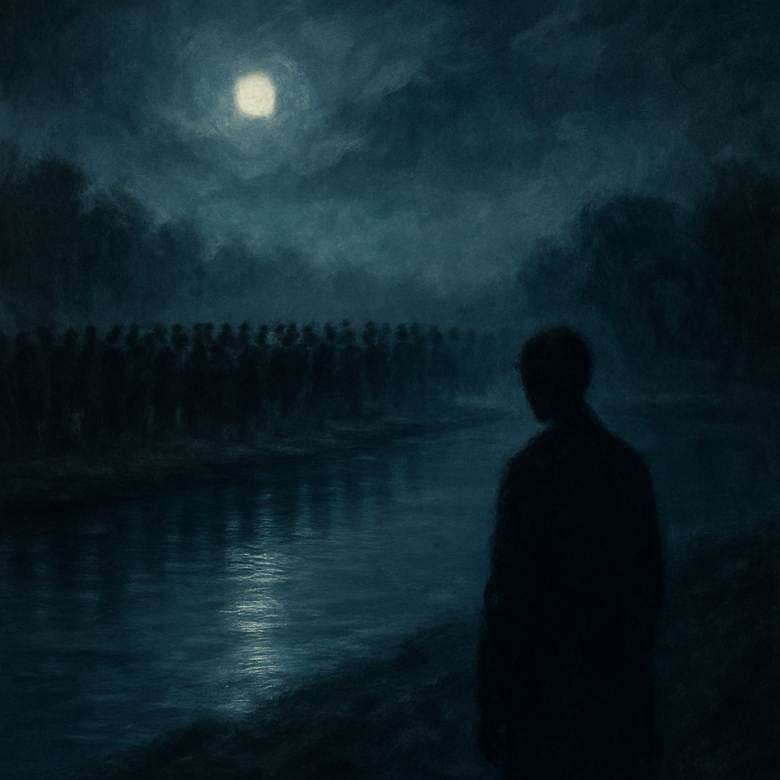
Somewhere between waking and dreaming, an image pressed in: a crowd in the distance, faceless yet intent, waiting in a place I half-remembered. It felt like the breath before a word, or the pause before a door opens—as if they already knew I was coming, or they were the ones who called me here.
Then the house was mine, the river close, and the crowd began to grow.
The house was mine, though I could not remember buying it. Its rooms held the kind of stillness that makes impatience louder. Outside, a river slid past, slow and brown, marking the edge of the property.
Beyond the far bank, a crowd had begun to gather in the failing light. They stood between me and the main road, their attention fixed on me in a way that felt too direct, too heavy. I didn’t know what they wanted, only that their eyes followed every shift of my posture.
Their stillness unsettled me more than if they had been shouting. As darkness thickened, more figures emerged from the shadows, doubling their numbers, then doubling again.
My uncle appeared on the path, carrying a plate of food. He smiled the way he always had when I was small—as if I’d done something worth his trouble. To reach the house, he would have to pass through the crowd.
The news came fast and vague: the crowd had taken him. Some said they had beaten him, some whispered worse. I refused the worst, holding the thought away as if my will could erase it.
Anger rose, quick and hot. The river glinted in the corner of my eye, the crowd breeding itself in the shadows—dozens becoming hundreds, their murmur rising like a tide. I knew—in that peculiar dream-knowing—that I could do something, shift the current of the moment, if I chose.
But my chest tightened with worry, my mind torn between protecting him and facing them. Somewhere beneath the heat in my chest, I knew the crowd wouldn’t bend to a voice shaken by fear. Influence was possible, but only through a steadiness I couldn’t find. The two desires strained against each other until I turned away, retreating into the house, the walls closing around me like a pause I couldn’t escape.
Later—in a way that didn’t follow time—the crowd remained, but daylight had returned, and they were different. No longer the multiplying shadow-mass of night but a warm collective waiting for me to step forward. My uncle was gone, and the relief was quiet, solid.
Then came a message, as clear as if he had spoken it into my ear: I’m in town. Let’s have dinner. I saw him whole, the plate of food still in his hands, the river and the road both open.
I stood at the threshold, feeling the space between the house and the crowd, between the self I guarded and the one they saw.
The river flowed on, patient as ever.
Enjoying the content? Share the publication with your network and subscribe for future stories and updates.
Explore more:
Home | Archive | About this Publication | FAQs | Copyright & Usage Notice | From Her Journal | Process and Drafts | All Posts in The Notebooks