The ceiling holds an eye that never blinks.
I feel it before I notice it—an overhead presence tucked into the grid of white panels, a small dark bead angled down toward the aisles. It watches in the way a building watches: without breath, without opinion, with an endless appetite for shapes.
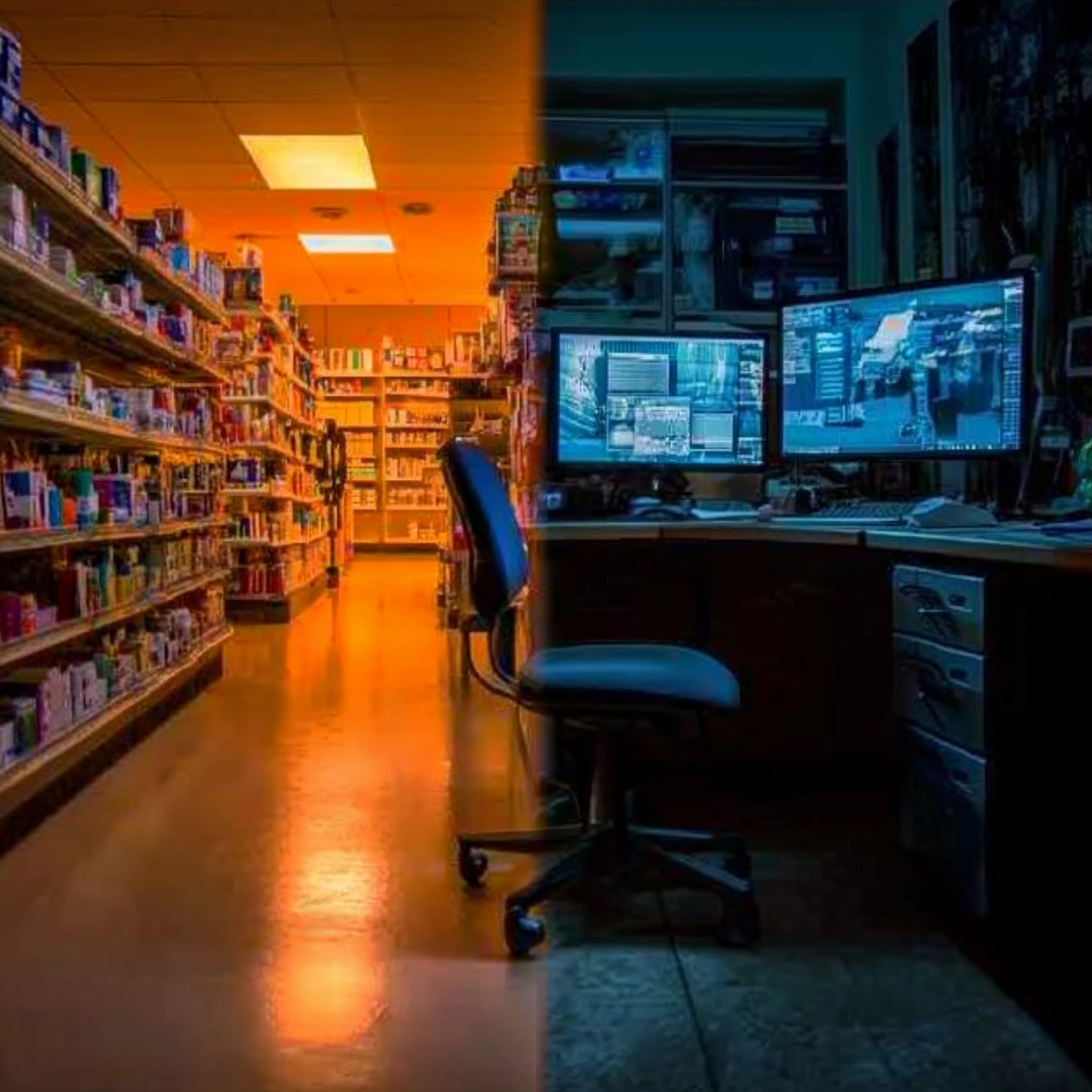
The store is bright enough to erase shadows. Everything shines a little, like it’s been freshly unwrapped. The air carries the mixed scent of detergent, plastic, warm bread, and something medicinal. Carts roll by with a gentle rattle, their wheels speaking in soft clicks over the seams in the floor.
I’m here for a small thing. Relief in a bottle. A simple errand, the kind that belongs to ordinary life.
Ahead, a woman moves through the aisle in a motorized cart. The machine hums with a patient persistence, like it has its own intention. A child rests on her lap, loose-limbed and trusting, and another child rides lower, perched near the front as if the whole contraption is a playful ship. Their bodies sway together as they turn, a shared rhythm.
I draw close, looking for the shelf where the small relief lives.
The cart clips the corner of a display.
It’s minor, almost nothing—foam, cardboard, a little jolt. Yet the jolt travels. It passes through the machine into the woman’s posture, into the child’s center of gravity. The child tips, a quick angle toward falling, and in that instant time does what it always does: it narrows.
My hand moves before my mind finishes naming what I see.
It reaches because the body knows certain arcs: falling, breaking, impact. It reaches because a small body carries the fragile physics of bones still learning their limits. It reaches because I understand gravity, and for a moment I want to interrupt it.
I touch—fabric, warmth, the light resistance of a living weight. A brief lift. A brief steadiness.
The woman’s arms pull in reflex, quick as a blink. Her whole body tightens around the child. Her eyes widen in a way that changes the atmosphere. A line appears between us where there had been none, and it feels charged, like a wire that’s suddenly been stripped.
The older child looks up, alert, reading the room with an animal clarity.
A sentence rises in the woman’s face. Her mouth forms something sharp, a sound shaped like alarm. Her hand comes back toward the child, toward me, toward the place where my gesture still hangs in the air.
For a beat, we exist inside two different stories that occupy the same space.
I step back. My palms open without being asked, as if they can speak in the only language they know: empty, visible, soft.
My heart moves faster for a moment, then finds its rhythm again. I point down the aisle toward what I came for, as if purpose can smooth the moment. I speak in a calm voice, and my words feel like thin paper smoothed over a crack.
She gestures away. The motor hums again. The cart continues.
The store resumes its ordinary music.
I find the small bottle. I hold it for a second longer than necessary, reading its label like it’s a blessing. When I reach the front, I pause near an employee and ask a question I already know the answer to, simply to anchor myself in the publicness of the place. The employee answers. Their voice is normal. Their face is neutral. The exchange leaves a small footprint in time.
A receipt prints. The doors breathe open. I step out carrying relief in my hand, and the night air meets my skin like a clean cloth.
Six minutes. Seven.
A handful of minutes with edges I can’t see yet.
—
Later, I’m in a room with screens.
The light here is different—blue and quiet, like deep water. Chairs are arranged as if for a lesson. People sit forward with the attentive hunger of those who want certainty. A figure stands at a console, a keeper of time, fingers poised over buttons that move the past back and forth.
On the main screen, the aisle appears again.
The overhead eye offers its gift: a flat world of angles, no sound, no heartbeat, no inner weather. People become outlines. Gestures become symbols. The cart becomes a moving object. The display becomes a corner.
And there I am: a body entering the frame, pausing, turning.
The keeper of time presses a button and the moment repeats. The corner. The clip. The sway. The child’s tilt. My reach.
03:17:08 — HAND ENTERS FRAME
INTERPRETATION: help
INTERPRETATION: taking
The footage has no preference. It holds.
Someone in the room says a word that hardens the air.
Someone else says a different word, and the room shifts toward it. Heads nod. Faces tighten. The word gains weight simply by being spoken with confidence.
The screen continues: my arms lift. The woman reaches back. The child returns to her lap. I step away. I walk down the aisle. Later, I pay. Later, I pause at the front. Later, I exit.
The keeper of time pauses the footage on the fraction where my hand makes contact.
03:17:09 — CONTACT
A single frame, and the room rushes in to finish it.
“Right there,” someone says, as if pointing at a single frame can settle the entire human question.
The group leans in.
They are looking for the frame where a person becomes a verdict.
A voice asks me what I see.
It feels like a test dressed as a question.
I watch the screen and answer with the simplest truth I can find: a body interrupting a fall.
Someone answers back with another truth: a body taking what isn’t offered.
The same frame holds both meanings with perfect indifference.
It’s an astonishing thing how quickly language decides what the eye is allowed to witness.
The keeper of time scrubs backward. The moment plays again. The moment plays again. The moment plays again.
Each replay gathers more confidence from the room, as if repetition itself generates proof.
I begin to understand something about the overhead eye: it preserves shape.
The room supplies the caption.
The screen shows my open palms after, and someone calls that “performance.” The screen shows my step back, and someone calls that “calculation.” The screen shows the older child’s gaze, and someone calls that “fear.” The screen shows the woman’s pull, and someone calls that “instinct.”
Every gesture becomes a noun with a blade in it.
I feel my own body among them, and I notice how easily a crowd can form a single throat to deliver a sentence.
The keeper of time pauses again—my hand, the child, the brief lift.
I want to speak into the footage. I want to add the part that lives inside the gesture: the flash of physics, the reflex to protect, the half-second where gravity looked negotiable.
The screen offers its usual silence.
So I begin practicing a small spell in my mind, a new grammar I can carry into bright places:
Walk away—
because the story can tip faster than the body can explain itself.
On the screen, the overhead eye keeps holding the shape of my hand in the air.
In the room, the crowd keeps choosing its subtitle.
Somewhere between the two, a life becomes a sentence.
And I sit there listening to the blue light, wondering what the same gesture will be called next time—
when it belongs to another body,
when it happens under another ceiling,
when the eye in the tiles keeps watching,
storing shapes for a world that loves to name them.
Wander through Stomari’s archive or choose a different room below.
Explore more:
Home | Archive | Reader Guide | Copyright & Usage Notice | From Her Journal | Process and Drafts | MABST | MAKARI | PANOMA | STOMARI