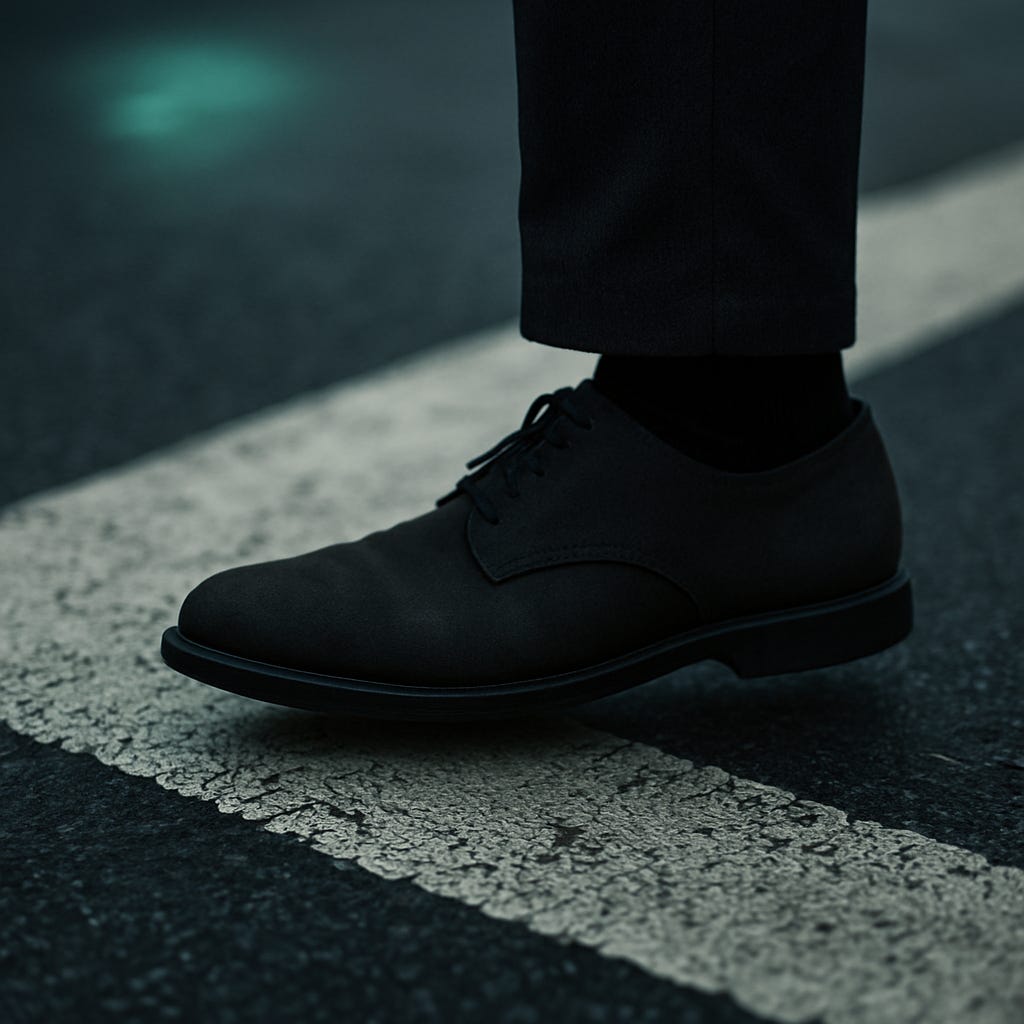
Main Street was designed to look trustworthy.
Clean lines, clear signage, polite symmetry. It ran straight through the heart of town—the kind of place where they say kids used to ride bikes and mayors shook hands. The kind of place where fairness and order were still supposed to mean something.
And maybe they did. Once.
The light was green. That was the important thing.
A man in a tan overcoat stepped off the curb with a paper cup in one hand and trust in the other. The white walking figure flashed on the signal post—not a command, exactly, just an invitation dressed like one.
He was halfway across when the truck came.
It didn’t stop. It didn’t even swerve.
The contact was small and exact, a quiet, mechanical thunk. Not enough to send him sprawling, just enough to fold him inward and remind his bones of the rules. He hunched and coughed once—a sharp, involuntary bark—then kept moving.
By the time he reached the opposite curb, he was blinking like someone who’d walked into the wrong scene. He adjusted his coat, nodded to no one, and carried on as if the whole thing were his fault.
From a folding chair nearby, a man with a bruised apple and a calm expression looked up.
“Every time,” he said. “You can tell who’s driving.”
The truck groaned past me, trailing diesel and denial. The signal still blinked white.
Across the street, a vendor waved lazily from behind a cart that said FRUIT & MEDIA.
“You’re good,” he called. “They fixed the system. Better than before.”
Behind him, a city-issued vest crouched at the control box. Thin fingers moved quickly—unplug, twist, reconnect. One yellow diode blinked three times. Then twice. Then nothing.
The technician didn’t look up. He closed the box and walked away like someone who had no idea what kind of signal he’d just sent.
The green light stayed green.
Put a pin in the box with wires. We’ll be back.
The signal still said walk.
Another day, a young couple stepped out, laughing about something that no longer mattered. The SUV clipped them at the centerline—not hard enough to hospitalize, just hard enough to erase the laugh. She bent over, stunned. He stared at his hands like they belonged to someone else.
Neither spoke. Something collapsed between them, quiet as a seam letting go.
The signal still said walk.
The vendor added a laminated sheet to his awning: NARRATIVE BUNDLE—“IT’S JUST THE WEATHER”— $19.99. He smiled with the easy grace of someone who knew survival was a kind of silence—and sales a kind of blessing.
“Best-seller,” he said.
The next morning brought an older woman with a cane and a grocery bag. She paused, just long enough to register the silence, then began her crossing. Two stripes in, a black SUV blew the stop sign. No brake. No recognition of presence. Just motion. Along its side, glossy black on black: RECESSION, the kind of lettering you see only if you know to look for it.
The tap was clean enough to deny and hard enough to change how she stood. She didn’t fold. She stiffened—like someone afraid of falling twice.
Her posture said she was fine. Her shadow said otherwise.
The signal still said walk.
Later that day, a group stepped off together. No stroller, but the rhythm said family. Shoulder to shoulder. Matching pace.
The car came fast.
No warning. No scream. Only the sound—that strange split-second when something meant to be held together isn’t.
They hit the ground as one, but they did not rise as one.
“Is that normal?” I asked the vendor.
He shrugged. “Depends who you ask.” Then he lifted a lid on his cart to reveal neat stacks of headlines, talk-track cards, infographics on sticks. The fruit lived on one side. The stories lived on the other.
“We’ve also got the Both-Sides Starter Pack,” he said, fanning the cards: UNFORESEEABLE, UNLUCKY, NOTHING TO SEE HERE, ACTUALLY, IT HELPS. “Bundle and save.”
I bought the pack, pocketed half, and dropped the rest into a bin marked COMPOST. The vendor didn’t mind. Stories rot fast. He could always print more.
The signal still said walk.
Main Street, to the casual eye, looked fine. But the longer I watched, the more it shimmered, like the rules were running on backup power.
I remember when the convoys came through—WAR SPENDING printed bold on their sides, red lights blinking useless in their wake. The thunder sounded suspiciously like cash registers. I remember TAX CUTS—how they cheered when the billboard rose and looked away when it fell; tiny footnote at the bottom: Phase-in next quarter. I remember the van—BANK BAILOUT—blocking all four lanes for weeks. Not just any van. A masterpiece of dependence, built big enough, entangled enough, that we had to save it—while being told to walk it off.
So we walked. Around it. Through the smoke. Past the debt.
They got a rescue. We got a lesson. Maybe.
The lights were green back then, too.
The ticking from the control box grew louder the more I listened. A rule rearranging itself before it hit the street.
Across from the box, the Overlook Gallery’s loading dock took a delivery: a dolly stacked with binders—TRAFFIC CODE: REVISIONS—vanished into shadow.
Two floors up, behind a recessed pane, nine robed silhouettes stood—high and apart.
They didn’t wave. They didn’t need to.
The signal still said walk.
At home, I keep a corkboard because I like to pretend I’m neutral. By which I mean: I distrust the story I like best.
On red cards, I log the hits that fit. On blue, the misses that don’t. The blue column is thinner, stubbornly present. I run string between years and drivers; some lines stop at a blank pushpin labeled LAG—the space between setup and impact.
WHO’S DRIVING WHEN IMPACT LANDS ≠ WHO SET THE ROUTE, I write beneath it. It looks like the kind of truth that’s easy to sell and harder to live with.
In the margin: Put a pin in the box.
Twilight pressed the street flat and glossy. The box truck idled at the corner like a patient animal. The black SUV took a slow loop around the block. Then another. The tick inside the control box slipped offbeat.
“Don’t cross when they’re driving,” said a voice behind me.
I turned, but Main Street had already perfected the art of saying things without owning them.
The walk icon blinked white—cheerful, oblivious. The street held its breath.
I placed one foot into the street, then pulled it back.
“Not this time.”
The signal turned red, preserving the illusion it had always been in control.
Wind moved. The crosswalk shed grit.
Main Street waited. It never rushes.
It just resets.
Enjoying the content? Share the publication with your network and subscribe for future stories and updates.
Explore more:
Home | Archive | About this Publication | FAQs | Copyright & Usage Notice | From Her Journal | Process and Drafts | All Posts in The Notebooks